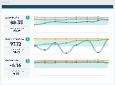


Call center analytics is the practice of capturing, measuring, and interpreting customer interaction data to improve agent performance, operational efficiency, and customer experience. Modern analytics platforms use AI-powered speech and text analysis to evaluate every interaction across phone, email, chat, social, and other channels - delivering actionable insights in real time. This improves performance by giving organizations the full context needed to optimize processes, boost compliance, and drive measurable business outcomes.
How does call center analytics work?
Call center analytics platforms automatically collect and process data from every agent–customer interaction, often leveraging AI, natural language processing (NLP), and sentiment detection. These tools transcribe and analyze speech, parse written communications, and surface patterns in tone, keywords, and behavior. The resulting structured data can be tied to KPIs like average handle time (AHT), first call resolution (FCR), and customer satisfaction (CSAT) to pinpoint improvement opportunities. This automated approach provides a more accurate, unbiased, and scalable view of performance compared to traditional manual reviews.
What are the most important KPIs to track in call center analytics?
While every operation varies, the most impactful KPIs for call center analytics often include:
- First Call Resolution (FCR): Percentage of issues solved in the first contact.
- Average Handle Time (AHT): Total time to resolve an interaction.
- Average Speed of Answer (ASA): How quickly customers connect to agents.
- Abandoned Call Rate: Percentage of customers who disconnect before speaking to an agent.
- Customer Satisfaction (CSAT) & Net Promoter Score (NPS): Direct measures of loyalty and service quality.
Tracking these consistently enables leaders to link operational improvements with ROI, training needs, and CX outcomes.
What are the advantages of AI-driven analytics over traditional call quality monitoring?
AI-driven analytics provide a significant advantage over traditional quality monitoring by replacing small, subjective sample sizes with comprehensive, data-driven insights. Legacy quality monitoring often samples a small percentage of calls, manually reviewed for compliance or coaching. AI-driven analytics can automatically capture and score 100% of conversations across all channels, reducing bias and surfacing insights in real time. This enables timely coaching, faster resolution of systemic issues, and improved process compliance. The breadth of omnichannel coverage ensures customer sentiment and intent are understood holistically, not just from phone conversations.
How does analytics improve agent performance and coaching?
With analytics delivering detailed, objective data on each interaction, supervisors can give feedback that is targeted, consistent, and tied to actual performance trends. Real-time prompts can guide agents during live calls, while post-interaction analytics identify skill gaps and best practices. Personalized coaching plans developed from data (not just opinions) lead to higher engagement, lower churn, and measurable improvements in key metrics.
What ROI can organizations expect from implementing advanced call center analytics?
Businesses adopting automated, omnichannel call center analytics often see the following ROI:
- Reduced AHT and ASA through more efficient call routing and resolution
- Higher FCR rates, leading to increased customer satisfaction and loyalty
- Lower compliance risk through automated monitoring and alerts
- Optimized staffing from data-backed forecasting
- Improved revenue retention and upsell opportunities through proactive engagement insights
The combination of cost reduction and revenue uplift delivers a strong, provable ROI within months.
How does call center analytics support security and compliance?
Call center analytics platforms can detect and flag compliance risks in real time, from PCI data capture attempts to prohibited language or policy deviations. Automated redaction and secure data handling help meet data privacy standards like GDPR, HIPAA, and CCPA. Detailed audit trails enable rapid response to disputes or regulatory inquiries, ensuring customer trust is maintained.